British Navy
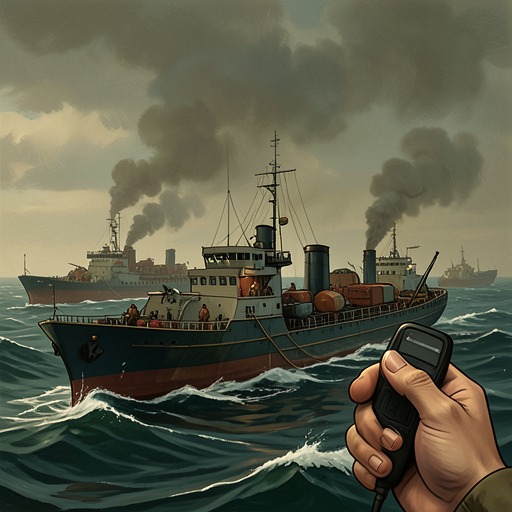
The Good ShepherdThe British Navy is invoked as the measure of the convoy’s strategic value: if the tanker Hendrikson reached England, its oil could give the entire fleet an hour of steaming. The reference turns an otherwise abstract cargo into a resource with consequences beyond its price, linking the survival of individual ships and the decisions of their escort commander to the larger Allied war effort.
Strategic Value of the Convoy’s Cargo
The narrative contrasts the company’s accounting value for Hendrikson and its oil—together, half a million dollars—with what their safe arrival would mean. An hour of steaming for the British Navy could not be adequately expressed as a market price; its importance lay in the freedom and operational capacity that fuel could provide during wartime. The tanker’s cargo therefore matters not simply as property to be protected but as a resource whose destination gives the convoy wider strategic significance.
That contrast also shapes the account’s treatment of responsibility. The convoy carries thousands of people and valuable cargo, but the monetary totals cannot capture the stakes of its passage. The British Navy supplies a concrete scale for those stakes: one ship’s delivery could support the movement of the whole fleet, making the convoy’s safety consequential well beyond the individual vessels within it.
Allied Command and Shared Stakes
The convoy is under the command of George Krause, an American officer placed in charge of an Allied escort whose captains include officers of other nationalities. His decisions are therefore situated within a multinational command structure, where the operational consequences of action or restraint matter alongside the judgments made by officers and governments across the alliance. The narrative identifies Allied goodwill as relevant to ultimate victory, while emphasizing that it increases the weight of Krause’s responsibility rather than changing the calculations on which he must decide.
The British Navy is not shown issuing orders or directly participating in these scenes. Instead, it stands within the wider Allied purpose that gives the convoy’s passage its meaning. The fleet’s dependence on the Hendrikson’s oil makes the protection of the merchant ships part of a common strategic undertaking, even as command remains concentrated in Krause and the immediate decisions belong to the escort.
Protection, Resources, and Limits
That protection depends on a small screen of four fighting ships. Detaching James to pursue a sonar contact could reduce convoy coverage and leave gaps through which other U-boats might approach; the pursuit could also consume scarce fuel as the ship searched and then worked to rejoin the convoy. Krause weighs the possibility of destroying a submarine against those costs and the danger that an unchallenged U-boat might report the convoy’s position or help direct a larger attack. The British Navy’s strategic interest in the cargo is thus connected to a chain of immediate, uncertain escort decisions, not to any guarantee that the convoy will arrive safely.
The strain extends from ships and fuel to crews and equipment. Calling Keeling to general quarters would put every sailor at duty stations, but prolonged battle stations would interrupt sleep, meals, and routine maintenance. Krause keeps the ship at Condition Two rather than imposing the more exhausting state without sufficient reason, and later removes a routine general-quarters call so the watch below can have a full four hours’ rest unless an emergency occurs. This effort to preserve the crew’s capacity forms part of the same practical problem as maintaining the escort screen: protection requires readiness, but readiness itself must be sustained.
The limits are also visible in the dwindling supply of depth charges. After more than seven tons of explosives have been expended in a day, Keeling has only six charges remaining, so Krause orders an end to firing further patterns. Smaller patterns would sharply reduce the chance of a hit, although even a single explosion could force a U-boat to evade. These finite stores, like the escort’s fuel and the crew’s endurance, show the material conditions beneath the convoy’s strategic importance. The British Navy’s hour of steaming depends, in the narrative’s account, on a precarious system of ships, people, and supplies working under pressure.